A Comparative Study of Learning Difficulty Between Classical and Folk Guitar
The guitar is one of the most widely played musical instruments across cultures and genres. Among its various forms, the classical guitar and the folk (or acoustic steel-string) guitar are two of the most popular choices for beginners. However, despite their similarities in structure and tuning, the learning processes and technical requirements for each differ significantly. This article explores the relative difficulty in learning classical guitar compared to folk guitar, focusing on technique, physical demands, and educational context.
Classical guitar is traditionally associated with formal training and structured pedagogy. It is typically played using fingerstyle technique, requiring each finger of the right hand (for right-handed players) to be independently coordinated. Students are expected to develop precise tone control, dynamic expression, and articulation, often through classical repertoire and reading standard musical notation. Additionally, classical guitar posture is strict: players must hold the guitar on the left leg, often with a footstool or support, to facilitate accurate finger placement and control.
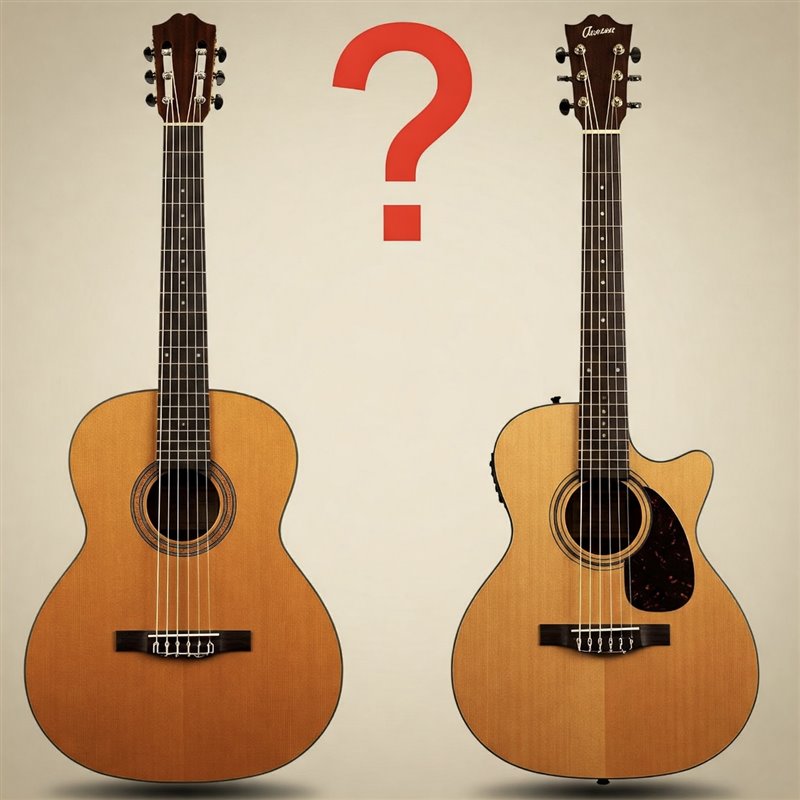
The fingerboard of a classical guitar is also wider than that of a folk guitar, making it more challenging for beginners to stretch their fingers across the frets, particularly when forming chords or playing complex passages. While the nylon strings used in classical guitars are softer and gentler on the fingertips compared to steel strings, the precision required in finger placement can offset this physical comfort.
In contrast, the folk guitar—commonly used in pop, rock, country, and folk music—is generally seen as more accessible to beginners. Its narrower neck and use of plectrum (pick) or simplified fingerpicking techniques allow for a quicker grasp of basic chords and rhythmic strumming patterns. Furthermore, folk guitarists often learn through chord charts and tablature rather than formal sheet music, making the learning process less intimidating for self-taught learners.
The nature of the music associated with each guitar type also contributes to perceived difficulty. Classical guitar emphasizes solo performance and interpretation of written compositions, requiring musical literacy and discipline. Folk guitar, on the other hand, is often used in accompaniment, group playing, or songwriting, which offers more immediate gratification and creative flexibility.
In conclusion, while the classical guitar offers a rich, expressive medium for musical development, it generally demands more technical discipline, formal study, and physical coordination than the folk guitar. For this reason, many beginners perceive the classical guitar as more challenging to learn, particularly in the early stages. Educators and learners should consider these differences when choosing an instrument to align with their goals, musical interests, and preferred learning styles.
← Back to Guest Book
Other Topics
Admin
Yamaha CGS102AII 1/2 Size Classical Guitar – A Perfect Start for Young Players
The Yamaha CGS102AII is a half-size classical guitar designed specifically for young beginners and players wit...
Posted on: 2025-04-29 02:14:02
From: 180.180.28.188
Read more
Admin
Cordoba Stage 6-String Electric Guitar: A Fusion of Tradition and Innovation for the Modern Performer
In an era where versatility is paramount, the Cordoba Stage 6-String Electric Guitar emerges ...
Posted on: 2025-05-05 01:29:27
From: 101.108.215.6
Read more
Admin
Romance De Amor is beautiful on classical guitar. Its sweet flowing character (dolce legato) as in the sheet music at [...
Posted on: 2025-04-28 04:50:37
From: 101.51.38.193
Read more
Admin
Here&;#39;s how to play the C7 chord as shown in the image: the numbers 1, 2, 3, and 4 indicate the index, middle, ring, and pinky fingers respectively. You can find more chord diagrams on ...
Posted on: 2025-04-27 23:31:04
From: 118.174.163.65
Read more
Admin
A Structured Approach to Learning Classical Guitar: From Beginner to Proficient Level
Abstract
This article outlines a systematic approach to learning classical guitar, from the beginn...
Posted on: 2025-05-07 19:40:30
From: 1.47.129.116
Read more
Admin
Academic Review: Cort Solencanto Premium Classical Guitar
Introduction
The classical guitar remains a central instrument in both educational and performance contexts, particularly with...
Posted on: 2025-05-07 21:49:59
From: 1.47.129.116
Read more
Admin
Unbiased Review: Cordoba Protégé C1 Matiz Classical Guitar – Pale Sky Finish
The Cordoba Protégé C1 Matiz aims to offer something different in the world of classical gui...
Posted on: 2025-05-04 01:26:43
From: 125.25.214.203
Read more
Admin
An Academic Review of the Cordoba Fusion 5 Sonata Burst: A Hybrid Approach to Nylon String Guitar Design
Abstract
The Cordoba Fusion 5 Sonata Burst represents an innovative approach to...
Posted on: 2025-05-04 07:21:46
From: 125.25.214.203
Read more
Admin
How to play C minor chord on a guitar: The image shows a C minor chord on a guitar. The horizontal lines represent the strings (E, B, G, D, A, E from top to bottom), and the vertical lines are the fre...
Posted on: 2025-04-27 08:20:27
From: 118.174.163.65
Read more
Admin
Master the G Major Scale with This Interactive Guitar Tool from Midlife Guitar
Are you looking for a fun and effective way to practice the G Major scale on guitar? The G Major Scale Guitar ...
Posted on: 2025-05-03 19:08:39
From: 180.180.30.191
Read more